The 2025 OECD–EUIPO report paints a troubling picture of Türkiye’s position in the international trade in counterfeit goods. Yet the same data also show why trademark registration in Türkiye matters not only for protecting the local market, but also for stopping counterfeits before they reach Europe.
Ranking near the top of international reports is usually good news for a country. Unfortunately, the positions Türkiye holds in Mapping Global Trade in Fakes 2025, published by the OECD and the European Union Intellectual Property Office (EUIPO), are not the kind we can be proud of.
Based on international customs seizure data for 2020–2021, the report identifies Türkiye as one of the leading source countries in the trade in fakes. Nor is this limited to a single product group. In clothing, footwear and cosmetics, Türkiye ranks among the very top countries in the world by various measures.
In Table 2.1 on page 17 of the report, Türkiye scores 1.000 on the GTRIC-e index, which measures the propensity of economies to be the source of counterfeit exports. This is the highest value on the index. Hong Kong, Lebanon, Syria, Andorra and Albania share the same score, while China scores 0.996.
| Provenance economy | GTRIC-e (2020–2021 average) |
|---|---|
| Hong Kong (China) | 1.000 |
| Türkiye | 1.000 |
| Lebanon | 1.000 |
| Syria | 1.000 |
| Andorra | 1.000 |
| Albania | 1.000 |
| Moldova | 0.998 |
| Cambodia | 0.997 |
| China | 0.996 |
| Sint Maarten | 0.992 |
The index does not directly show the share of counterfeits in a country’s exports. It is a relative risk indicator calculated from the value of seized goods and countries’ trade flows. It therefore cannot be concluded that Türkiye exports more fakes than China. Even so, the fact that Türkiye sits in the highest risk group is a cause for concern in itself.
Türkiye’s position in clothing, footwear and cosmetics
According to the report, China, Türkiye and Hong Kong are among the main sources of counterfeit clothing. The trade in fake clothing from Türkiye to European countries such as France and Bulgaria shows the problem’s direct link to the European market.
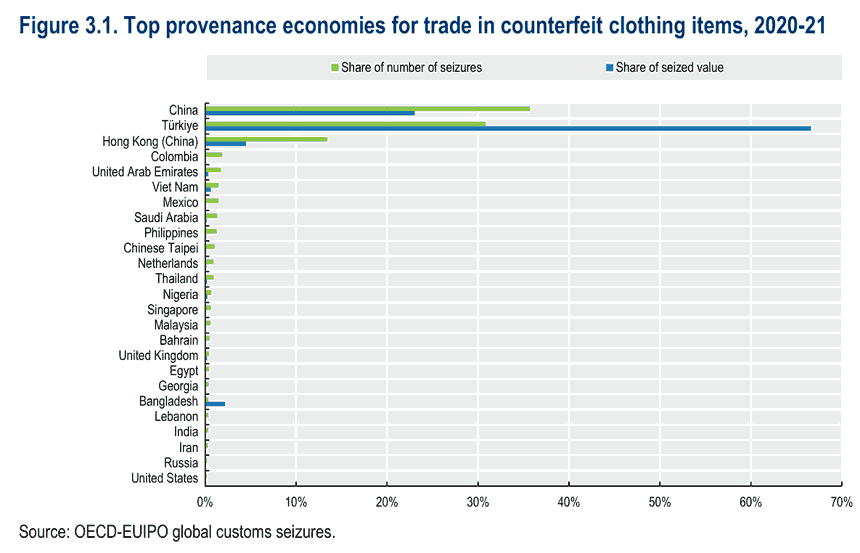
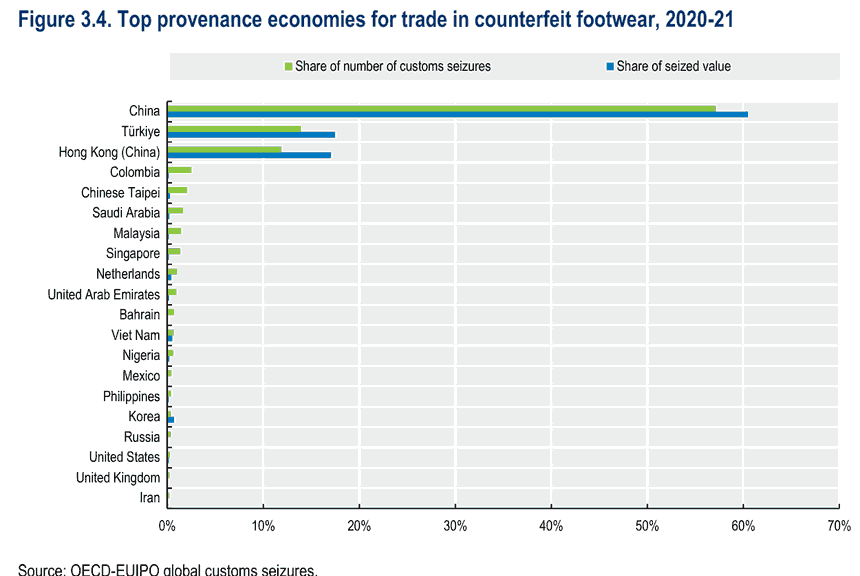
The picture in footwear is similar. Together, China, Türkiye and Hong Kong accounted for around 83% of worldwide seizures of counterfeit footwear in 2020–2021 and 94% of the total value of the goods seized.
The cosmetics data are even more striking. Türkiye and China are named as the source countries for a combined 92% of customs seizures involving counterfeit cosmetics. One detail deserves attention: Türkiye ranks first by number of seizures.
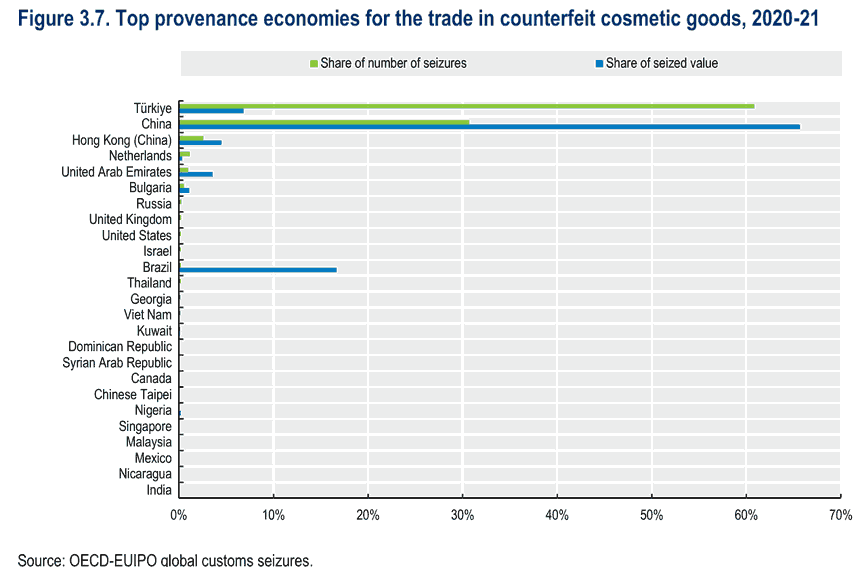
These results suggest that, despite public enforcement efforts, Türkiye’s role in the trade in fakes cannot be explained by a few isolated incidents.
The report does, however, have an important limitation: the fact that a product is recorded as originating from Türkiye does not necessarily mean it was manufactured in Türkiye. Türkiye’s geographical location and advanced logistics infrastructure can also make it easier for counterfeits produced elsewhere to be shipped through the country.
For this reason, production, export and transit trade need to be distinguished from one another.
Türkiye’s share of counterfeits reaching Europe
The European Union chapter of the OECD–EUIPO report examines Türkiye’s position separately.
By number of seizures of counterfeit goods destined for the EU in 2020–2021, China held a share of over 50%, followed by Türkiye with 22% and Hong Kong with 12%.
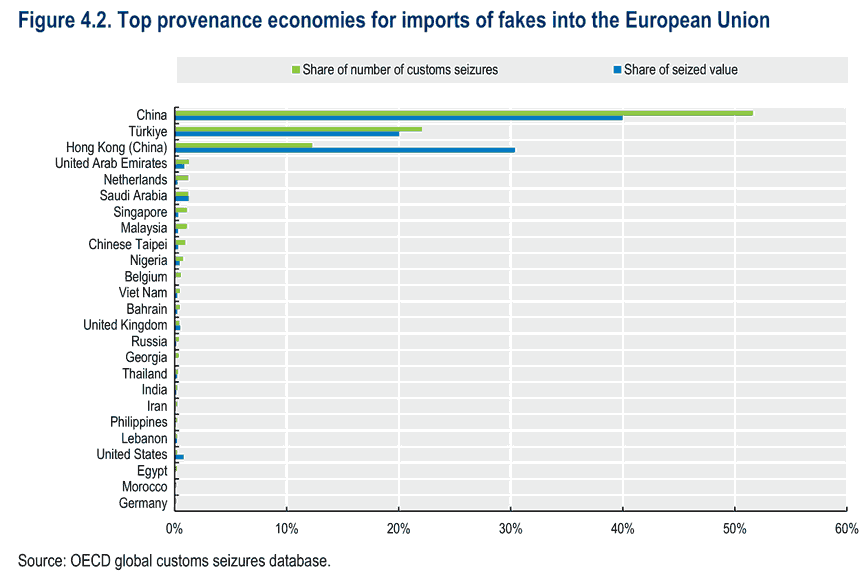
In other words, Türkiye is named as the source country in roughly one out of every five seizures of counterfeit goods destined for the EU.
More recent data also indicate that the problem persists.
According to the European Commission’s Türkiye 2025 Report, Türkiye ranked third among the source countries of counterfeit and pirated goods detained at EU customs in 2023. Türkiye accounted for 8.42% of the number of detentions at the EU’s borders and 12% of the value of the goods detained.
It should be borne in mind that the 22% figure for 2020–2021 and the 8.42% figure for 2023 are based on different data scopes and methodologies. The difference should therefore not be read as direct evidence that the trade in fakes has declined.
But the common conclusion of both reports is clear: Türkiye remains significant in the trade in counterfeits destined for Europe.
Why does trademark registration in Türkiye matter twice?
This picture raises an important question, particularly for foreign brand owners that do not yet do business in Türkiye:
If a brand owner has no plans to sell its products in Türkiye, why should it register its trademark in Türkiye?
The answer is not limited to potential sales in the Turkish market.
Türkiye lies on important trade routes between Europe, Asia and the Middle East. Counterfeit goods may be imported into Türkiye, but they may also be stored in customs warehouses or placed under transit procedures for shipment to other countries.
Data shared in the OECD–EUIPO report on seizures by Turkish customs in 2023 confirm this:
- 21% of seizures related to import procedures,
- 19% to transit procedures,
- 26% to warehouse operations.
These figures show that protecting intellectual property rights should not be thought of as limited to goods entering the Turkish market.
A trademark registered in Türkiye not only gives its owner legal protection against manufacturing, sales and distribution activities in the country, but also provides an important legal basis for measures that can be taken at customs.
Under Article 57 of Customs Law No. 4458 and Articles 100–111 of the Customs Regulation, it is possible to suspend customs procedures for, or detain, goods suspected of infringing intellectual and industrial property rights.
Right holders can apply through the Ministry of Trade’s electronic Intellectual and Industrial Property Rights Program to make information about their trademarks accessible to customs administrations.
This way, when customs officers encounter a suspicious shipment, they can access the relevant trademark right and the information provided by the right holder.
Of course, a trademark registration or customs recordal does not by itself guarantee that every shipment will be stopped. Particularly for goods in transit, the specific facts of the case, the applicable customs regime and the conditions for trademark infringement must be assessed separately.
However, where the necessary legal conditions are met, a customs intervention in Türkiye can prevent counterfeit goods from reaching distribution networks in Europe.
Viewing trademark registration in Türkiye merely as preparation for entering the local market is therefore an incomplete approach. Even for a business that does not sell in Türkiye but whose brand may be targeted by counterfeiters, Turkish trademark registration and customs protection can be a valuable part of its international brand protection strategy.
The work of Turkish customs in combating counterfeiting
Türkiye’s poor position in international rankings does not mean that counterfeiting is not being fought in the country.
The 2025 Activity Report on the Protection of Intellectual and Industrial Property Rights at Customs, published by the Ministry of Trade’s Directorate General of Customs on 27 January 2026, contains important information about the work in this area.
Since 2013, the Ministry has accepted right holders’ applications for customs protection electronically, and the applications are accessible to customs administrations throughout the country. According to the report, the increase in the number of applications that resumed in 2021 continued through 2025.
Concrete activities are also being carried out to train customs staff.
For example, in May 2025 a training session was held in Doğubayazıt attended by 50 customs officers and around 140 brand representatives. At another session in Mersin in October, 70 customs officers and around 150 brand representatives came together.
These sessions go beyond explaining the legislation. Brand owners present samples of genuine and counterfeit products, allowing customs officers to compare them physically.
It is also noteworthy that the Ministry’s 2025 activity report announces the introduction of AI-supported risk analysis at Turkish customs.
On the international cooperation side, there are training and information-sharing activities with Japan, European Union institutions and other countries. A regional seminar held in December 2025 brought together representatives of EUROPOL, INTERPOL, EUIPO and various European countries, as well as the Turkish Police and Gendarmerie.
These activities show that Turkish customs and law enforcement are open to international cooperation in the fight against counterfeiting and attach importance to building institutional capacity.
Naturally, the number of training sessions held or the technologies used do not by themselves prove that enforcement is sufficiently successful. For that, seizure results, the legal outcome of interventions and the development of the trade in fakes over time must be assessed together.
Still, when assessing the negative picture painted by international reports, the work of customs officers, police and other law enforcement officers in the field should not be overlooked.
Conclusion: an unfortunate picture, an important protection opportunity
Türkiye being named among the world’s leading source countries in the trade in fakes is a problem that deserves serious attention from the standpoint of industrial property protection.
Being associated with counterfeiting, particularly in sectors such as clothing, footwear and cosmetics where Türkiye has strong manufacturing and export capacity, can also damage the reputation of legitimate manufacturers and exporters.
The goal should therefore not simply be to seize more counterfeits. Preventing fakes from being manufactured, stored and introduced into international trade channels should also be a priority.
On the other hand, the trade routes revealed by the OECD–EUIPO report remind foreign brand owners of an important fact:
A trademark registration in Türkiye may be needed not only to protect customers and sales in Türkiye. An effective customs intervention in Türkiye can also prevent counterfeit goods from reaching customers in Europe.
Türkiye’s high ranking in the trade in fakes is bad news, but its strategic position in this trade, if used properly, can also make it an important point of intervention in the fight against international counterfeiting.
Making effective use of this opportunity depends on a strong legal protection framework, informed brand owners and sustained cooperation with customs administrations.
Sources
- OECD/EUIPO (2025), Mapping Global Trade in Fakes 2025: Global Trends and Enforcement Challenges. In particular Chapters 2, 3 and 4; Table 2.1, Table 3.1 and Figure 4.2. https://doi.org/10.1787/94d3b29f-en
- European Commission (2025), Türkiye 2025 Report, chapter on Intellectual Property Law. ab.gov.tr
- Republic of Türkiye Ministry of Trade, Directorate General of Customs (2026), 2025 Activity Report on the Protection of Intellectual and Industrial Property Rights at Customs (in Turkish). ticaret.gov.tr
- Republic of Türkiye Ministry of Trade, Intellectual Property Rights – Customs Procedures FAQ (in Turkish). ticaret.gov.tr
- Customs Law No. 4458, Article 57; Customs Regulation, Articles 100–111.
Charts: OECD/EUIPO (2025), Mapping Global Trade in Fakes 2025, © OECD/EUIPO 2025.