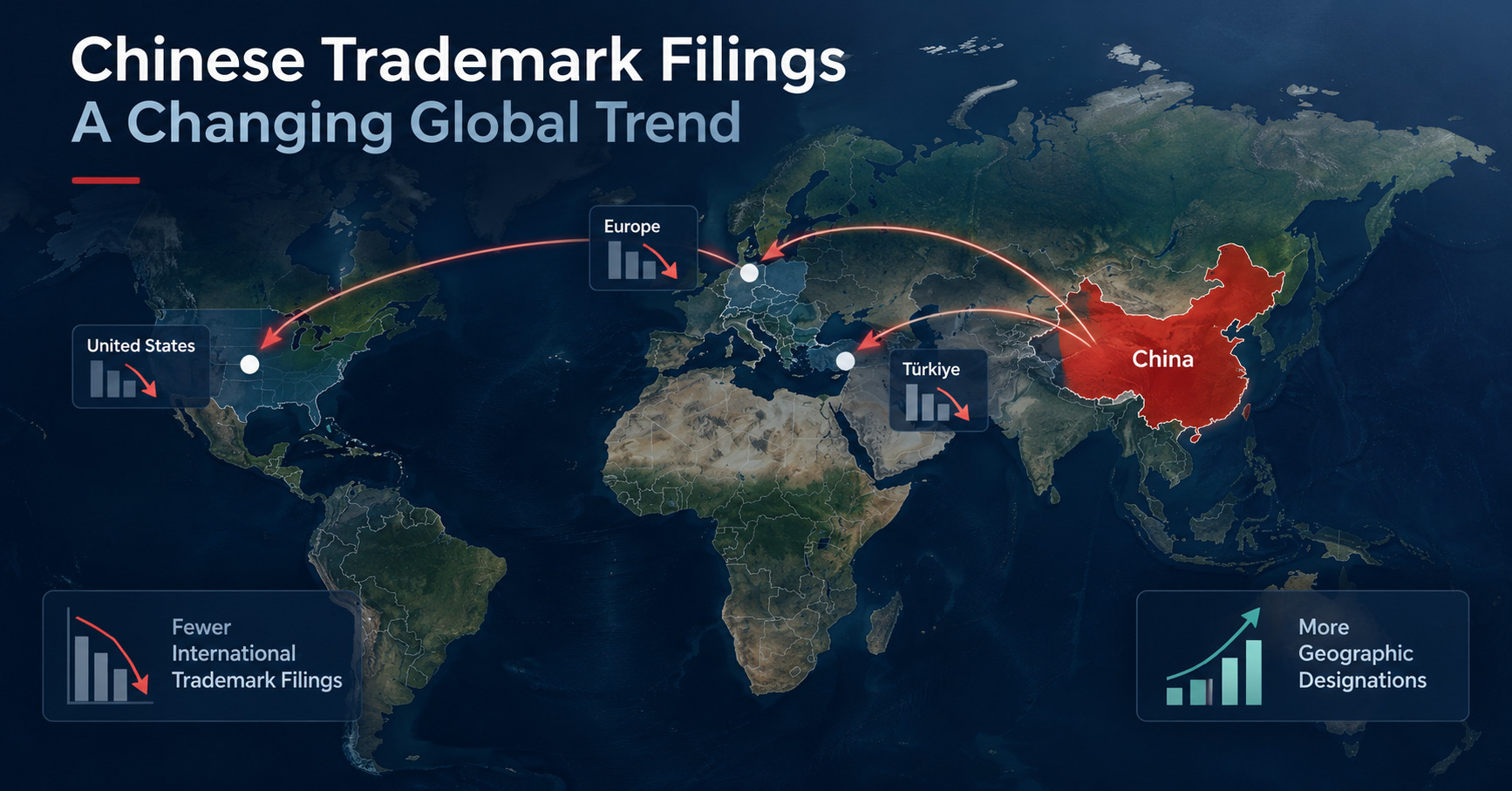
The decline observed in China-origin trademark applications in Europe and the United States became evident in Madrid applications designating Türkiye in 2026 as well. However, WIPO statistics point to a more complex shift in the international trademark protection strategies of Chinese companies.
China has long been one of the world’s largest sources of trademark applications. The country’s manufacturing capacity, export volume and weight in international e-commerce have also increased Chinese businesses’ demand for trademark protection abroad.
However, statistics published recently show that this trend is beginning to change.
While analyses on the decline in China-origin trademark applications in Europe and the US are being published, there is also a significant decline in application and registration numbers in China’s own domestic market.
Türkiye’s data is an interesting example of how this shift has emerged over time. Although China-origin trademark applications remained generally stable in the 2021–2025 period, a marked decline is visible in applications filed with Türkiye through the Madrid System in the first ten months of 2026.
To assess these developments, it is necessary to look together at the change in China’s domestic market, Madrid System statistics and international trade conditions.
Why are trademark applications declining in China?
According to data from the China National Intellectual Property Administration (CNIPA), total trademark applications in the country reached a very high level of approximately 9.45 million in 2021.
In 2025, this figure fell to approximately 6.95 million.
In the same period, the annual number of trademark registrations dropped from 7.74 million to 4.21 million.
| Year | Total trademark applications in China | Trademark registrations |
|---|---|---|
| 2021 | 9,450,507 | 7,738,947 |
| 2022 | 7,515,961 | 6,177,170 |
| 2023 | 7,188,336 | 4,382,714 |
| 2024 | 6,970,559 | 4,780,731 |
| 2025 | 6,952,550 | 4,205,797 |
Over the five-year period, applications fell by approximately 26.4%, while registrations fell by 45.7%.
Explaining this decline solely by a slowdown in the Chinese economy may not be accurate.
China was previously among the countries that implemented incentives to increase the number of trademark and patent applications. However, these policies also contributed to a large number of intellectual property applications being filed that did not stem from genuine commercial need.
In subsequent years, a stricter approach was adopted toward bad-faith trademark applications, marks with no intention of use, and speculative registrations.
In an analysis published in IAM in June 2026 by Chinese IP experts Zhu Zhigang, Paul Ranjard and Huang Hui, the decline in application numbers is also linked to the clearing of a backlog of unnecessary registrations accumulated in previous years.
It is therefore possible to say that part of the numerical decline stems not from a reduction in economic activity, but from trademark applications becoming more closely aligned with genuine commercial needs.
That said, the extent to which this shift in China’s domestic market explains the decline in applications abroad is not yet clear.
Is the decline in Europe and the US a sign of a broader shift?
International trademark statistics published in 2026 indicate that the number of China-origin applications is also declining in European markets.
According to Robert Reading’s assessment of the first nine months of 2026, China-origin applications fell by 14% in the United Kingdom and by 20% at the EUIPO.
Notably, total application numbers at these offices increased over the same period.
This suggests that the decline does not stem solely from a general contraction in trademark filing activity.
Assessments regarding the decline in China-origin applications also exist for the US market. World Trademark Review published an analysis addressing the fact that the decline in China-origin trademark applications has been observed in different international markets.
However, it does not seem possible to explain the shift in Europe and the US with a single cause.
Filing fees, uncertainties in trade policy, changes in Chinese companies’ export markets, and the reassessment of trademark portfolios can be counted among the possible factors.
What particularly needs attention here is that a decline in application numbers does not indicate that commercial activity in a given market has declined by the same proportion.
A company creating fewer new trademarks may continue to protect its existing trademarks in more countries.
Indeed, Madrid System statistics contain figures that also support this possibility.
Fewer applications, more country designations under the Madrid System
According to WIPO’s Madrid Yearly Review 2026 report, Chinese applicants filed 5,636 international trademark applications in 2025.
This figure is 4.9% lower than the previous year.
Despite this, China continued to be the third largest user of the Madrid System by number of applications, after the US and Germany.
The truly notable development is seen in country designations.
The total number of country/region designations made in China-origin international applications reached 76,530. This represents a 1.5% increase over the previous year.
As a result, China became the leading source of applications in terms of country/region designations under the Madrid System.
In 2025, Chinese applicants sought protection in an average of approximately fourteen (14) Madrid members per international application. The system-wide average is approximately seven (7) country designations per application.
These statistics raise an important possibility:
Chinese businesses may be filing international applications for fewer trademarks, but may be opting for broader geographic coverage for the marks they consider worth protecting.
In other words, the decline in application numbers may not mean that interest in international trademark protection has decreased to the same degree.
Of course, the increase in the number of country designations alone does not prove that this strategy has been adopted by all Chinese businesses. However, it is consistent with a more selective and geographically broader approach to trademark protection.
Has the decline begun in Türkiye as well?
China-origin trademark applications in Türkiye displayed a picture different from the international trend in the 2021–2025 period.
| Year | China-origin trademark applications |
|---|---|
| 2021 | 2,028 |
| 2022 | 1,960 |
| 2023 | 2,249 |
| 2024 | 2,316 |
| 2025 | 2,237 |
In 2025, the number of applications remained 10.3% above the 2021 level. However, Madrid System data for the first ten months of 2026 indicates that this picture is beginning to change.
The number of applications in which China-origin applicants chose Türkiye through the Madrid System fell from 1,387 in the January–October 2025 period to 969 in the same period of 2026.
This represents a decline of 30.1%.
It can therefore be said that the decline observed in Europe and the US has also begun to emerge with respect to Türkiye.
That said, Türkiye designations made through the Madrid System must be assessed separately from national applications filed directly with the Turkish Patent and Trademark Office. Total figures for applications filed directly with Türkiye in 2026 have not yet been included in this comparison.
For this reason, current statistics do not show that China-origin applications have declined at the same rate across all filing routes in Türkiye, but rather that a marked decline has occurred specifically in applications directed to Türkiye through the Madrid System.
Is a decline in trademark applications always a negative development?
The number of trademark applications can provide information about a country’s commercial dynamism. However, on its own, it does not measure the quality of applications or their economic value.
Developments in China’s own domestic market are an important example in this regard.
A decline in applications filed without genuine intent to use or on speculative grounds, even if it pulls down the overall statistics, can produce positive results for the functionality of the trademark register.
Similarly, a numerical decline in international applications can also occur alongside more careful trademark selection and more deliberate geographic protection.
For this reason, when assessing the decline in China-origin trademark applications, three separate indicators need to be distinguished from one another:
- For how many different trademarks is protection being sought?
- In how many countries do applicants want these trademarks protected?
- How much of the applications are related to genuine commercial activity?
In WIPO data, the decline in the first indicator alongside the rise in the second is one of the most notable signs of a possible shift in filing strategies.
Chinese companies may be changing their trademark registration strategies
Chinese companies may be acting more strategically in international trademark protection, more selectively determining which trademarks to protect and in which countries to file.
However, confirming this possibility requires a more comprehensive review of country-level application data for 2026. For example, data on whether there has been a change in the number of oppositions, and on the rate at which filed applications proceed to registration, could provide us with valuable insights.
If you would like to review your trademark portfolio in Türkiye or abroad in light of these shifting dynamics, you can contact us regarding our trademark registration and international IP portfolio management services.
Sources
- WIPO, Madrid Yearly Review 2026, 2025 international trademark applications and country designations.
- CNIPA, 2025 Annual Trademark Applications and Registrations Statistics.
- Zhu Zhigang, Paul Ranjard and Huang Hui, An Overview of Current IP Filing and Enforcement Trends in China, IAM, 24 June 2026.
- Robert Reading, 2026 assessment of the development of China-origin trademark applications in European markets.
- World Trademark Review, Trademark Applications from China Are on a Downward Trend Around the World.
- Turkish Patent and Trademark Office, China-origin trademark applications, 2021–2025, and Madrid System Türkiye designations, January–October 2025/2026.